> For the complete documentation index, see [llms.txt](https://docs.42.space/llms.txt). Markdown versions of documentation pages are available by appending `.md` to page URLs; this page is available as [Markdown](https://docs.42.space/getting-started/protocol-mechanics-101/42-outcome-tokens/post-resolution.md).
# Post-Resolution
What happens when market deadline has passed, or early resolution has been initiated.
Upon resolution or when the market deadline has passed, markets are no longer tradeable. Minting and redeeming cease, and OTs transition from speculative instruments to claims on value.
**Resolution** is the process by which an event concludes and the market collapses into a single set winning outcome(s). This step enforces the intrinsic value of OTs and guarantees a clean, deterministic end state for post-event reward distribution.
#### **Oracle Triggers & Resolution**
Each market is launched with **predefined resolution rules** and **deterministic oracle conditions**. These rules specify exactly how and when an outcome is considered resolved, removing ambiguity from the settlement process.
Once the oracle conditions are met:
* **One (or more) outcome(s)** declared as *correct\**
* All other Outcome Tokens are invalidated
* The market transitions from trading to settlement
{% hint style="info" %}
\**Multi-winning outcomes are supported but the initial phase will only include single-outcome markets.*
{% endhint %}
#### Single Winning Set
Resolution on 42 is **deterministic and final**. Every market resolves according to predefined rules and objective oracle conditions that produces a final settlement set unambiguous under the market’s specification.
In most markets, this settlement set corresponds to **one winning outcome**. However, depending on how a market is structured, resolution can also produce **multiple winning outcomes** (e.g., when the market definition explicitly allows a winning set rather than a singular outcome).
This means:
* **No discretionary payouts:** settlement is enforced strictly by the rules set at market creation
* **No probabilistic weighting at settlement:** probabilities are expressed through prices during trading, not injected at resolution
* **No subjective interpretation after the fact:** outcomes are resolved strictly according to the published resolution criteria
Once resolution occurs, the market converges to a **final winning set**, ensuring clarity for participants and enforceable payouts at the protocol level. This finality is what gives Outcome Tokens their intrinsic value and distinguishes eventcoins from open-ended speculative assets.
### **Claim**
After resolution, holders of the winning Outcome Token can claim their payout directly from the protocol. Claiming is permissionless and does not depend on counterparty actions or secondary market liquidity.
At this stage, trading ceases and the market transitions fully into settlement. Claims convert winning tokens into collateral, realizing the value accrued through correct positioning and market participation.
#### Payout Winnings
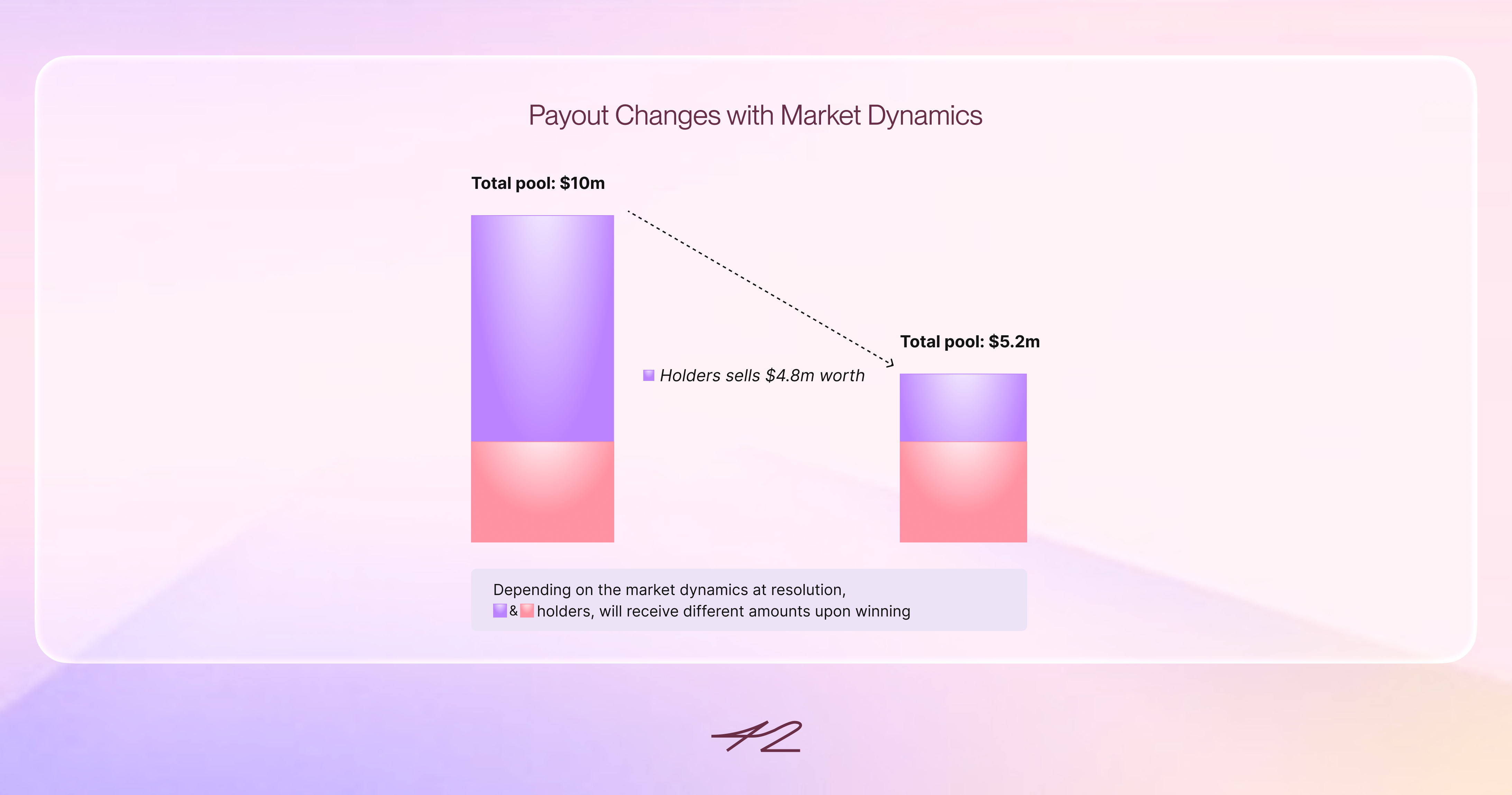
When the market concludes, all reserves are locked and distributed to holders of the **winning outcome token**. The payout per token is calculated as:
$$
Payout\_{\text{WinningOT}} = \frac{Market\_{\text{TotalReserves}}}{TotalSupply\_\text{WinningOT}}
$$
For each user, the total payout equals:
$$
UserPayout = Payout\_{\text{WinningOT}} \times QtyOwned\_{\text{WinningOT}}
$$
Given so, 42 markets essentially enable dynamic odds and open-ended room for both upside (and downside), where **returns are directly tied to timing, conviction, and accuracy**.
**In short:**
* The earlier you enter, the lower your cost basis.
* Magnitude of winnings depends on how the market’s state upon resolution, where your final payout may be higher or lower than your entry cost.
* You can enter and exit anytime to capture price action as a trader before the market resolves.
---
# Agent Instructions
This documentation is published with GitBook. GitBook is the documentation platform designed so that both humans and AI agents can read, navigate, and reason over technical content effectively. Learn more at gitbook.com.
## Querying This Documentation
If you need additional information that is not directly available in this page, you can query the documentation dynamically by asking a question.
Perform an HTTP GET request on the current page URL with the `ask` query parameter, and the optional `goal` query parameter:
```
GET https://docs.42.space/getting-started/protocol-mechanics-101/42-outcome-tokens/post-resolution.md?ask=&goal=
```
`ask` is the immediate question: it should be specific, self-contained, and written in natural language.
`goal` is optional and describes the broader end goal you are ultimately trying to accomplish on behalf of the user. GitBook uses it to tailor the answer towards what is most useful for that goal.
The response will contain a direct answer to the question and relevant excerpts and sources from the documentation.
Use this mechanism when the answer is not explicitly present in the current page, you need clarification or additional context, or you want to retrieve related documentation sections.