> For the complete documentation index, see [llms.txt](https://docs.42.space/llms.txt). Markdown versions of documentation pages are available by appending `.md` to page URLs; this page is available as [Markdown](https://docs.42.space/getting-started/protocol-mechanics-101/42-outcome-tokens/market-discovery-pre-resolution.md).
# Market Discovery (Pre-Resolution)
All you need to know about when the market is live.
42 markets are purpose-built for simplicity, with only three core actions: **Mint** (buy), **Redeem** (sell), and **Claim** (collect rewards).
During the **discovery phase**, markets are live and fully tradeable. Users can freely mint and redeem Outcome Tokens (OTs) as prices evolve and information emerges.
In this section, we’ll walk through how each action works in practice.
### **Minting (Buy)**
Minting is the process by which new **Outcome Tokens (OTs)** are created directly against the protocol. Unlike traditional markets, tokens are not matched against another participant or issued at a fixed price. Instead, they are minted via a **mint power curve** that responds to existing supply and incoming demand.
When a user mints, they deposit collateral into the market (USDT). The protocol calculates how many new OTs are issued based on:
* the current outstanding supply, and
* the size of the deposit along the curve.
Prices are **marginal**, and as supply increases, each additional token becomes more expensive.
{% hint style="info" %}
**Mint Example (For illustrative purposes)**\
\
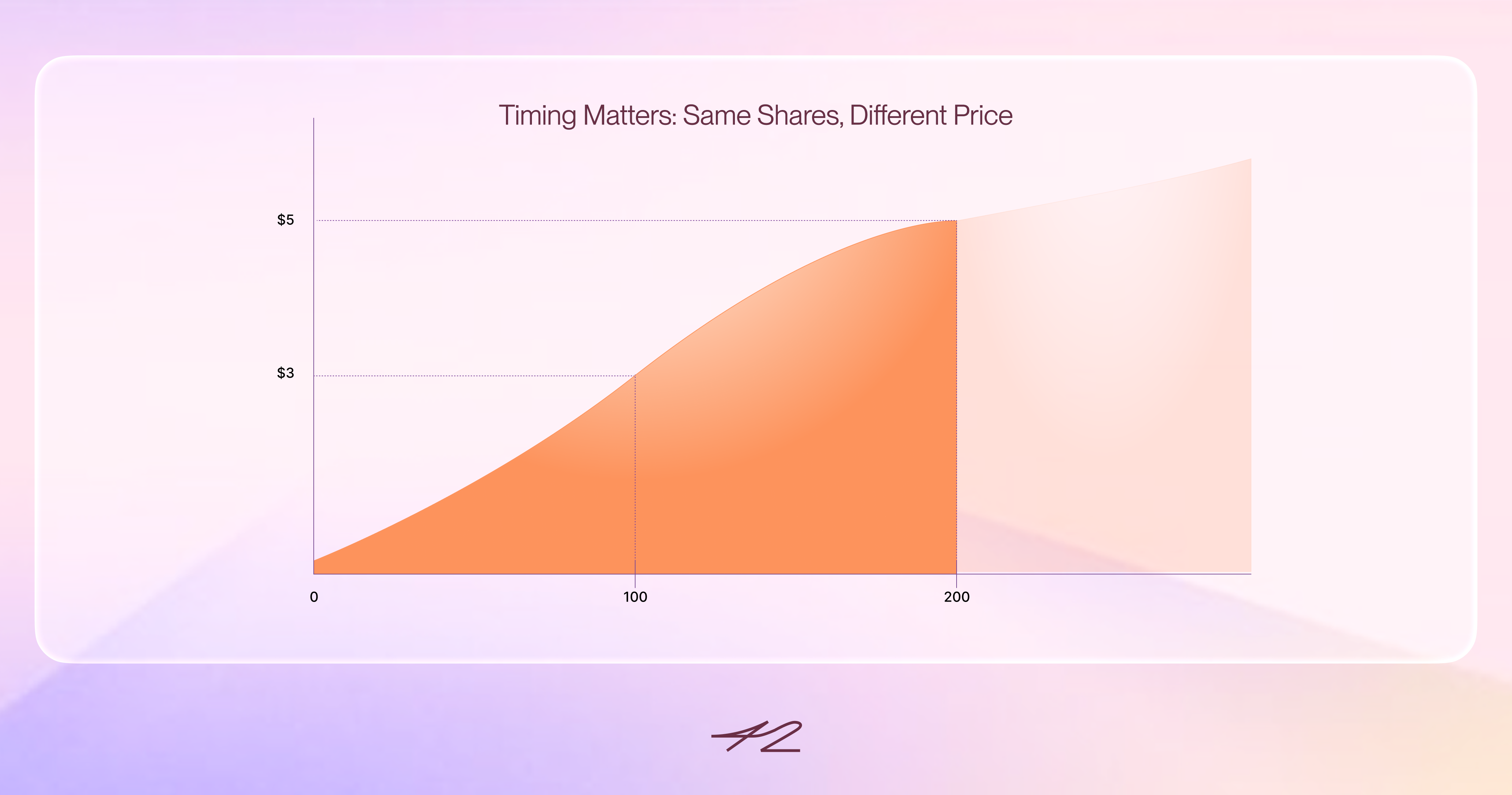
Suppose the current outstanding supply of an outcome token is **Q₁**, and the marginal mint price at that point is **$3**.\
\
If a user mints additional tokens, increasing supply from **Q₁ (100) → Q₂ (200)**, the marginal price rises along the curve which ends at **$5** at **Q₂**.
The user does **not** pay $5 for all tokens. Instead, the total cost is the **area under the mint curve between Q₁ and Q₂**. The user simply sends collateral equal to this total area, and the protocol issues the corresponding amount of Outcome Tokens.
{% endhint %}
### **Redeeming (Sell)**
Redeeming is the process by which OTs are converted back into collateral prior to resolution. When OTs are redeemed, they are removed from circulation and the effective supply decreases. Redemption pricing follows the inverse path of minting, moving **back down the mint power curve**.
Similar to minting, this ensures that participants can exit positions at any time, with pricing determined solely by current supply and market state.
When a user redeems tokens, the protocol:
1. **References the mint curve** to determine the theoretical value of the redeemed supply.
2. **Applies a redeem spread** at the order level.
3. Pays out collateral **below the mint-curve buy cost**.
4. Retains the spread inside the pool, increasing the eventual payout for remaining holders at resolution.
{% hint style="info" %}
**Redeem Example (For illustrative purposes)**\
\
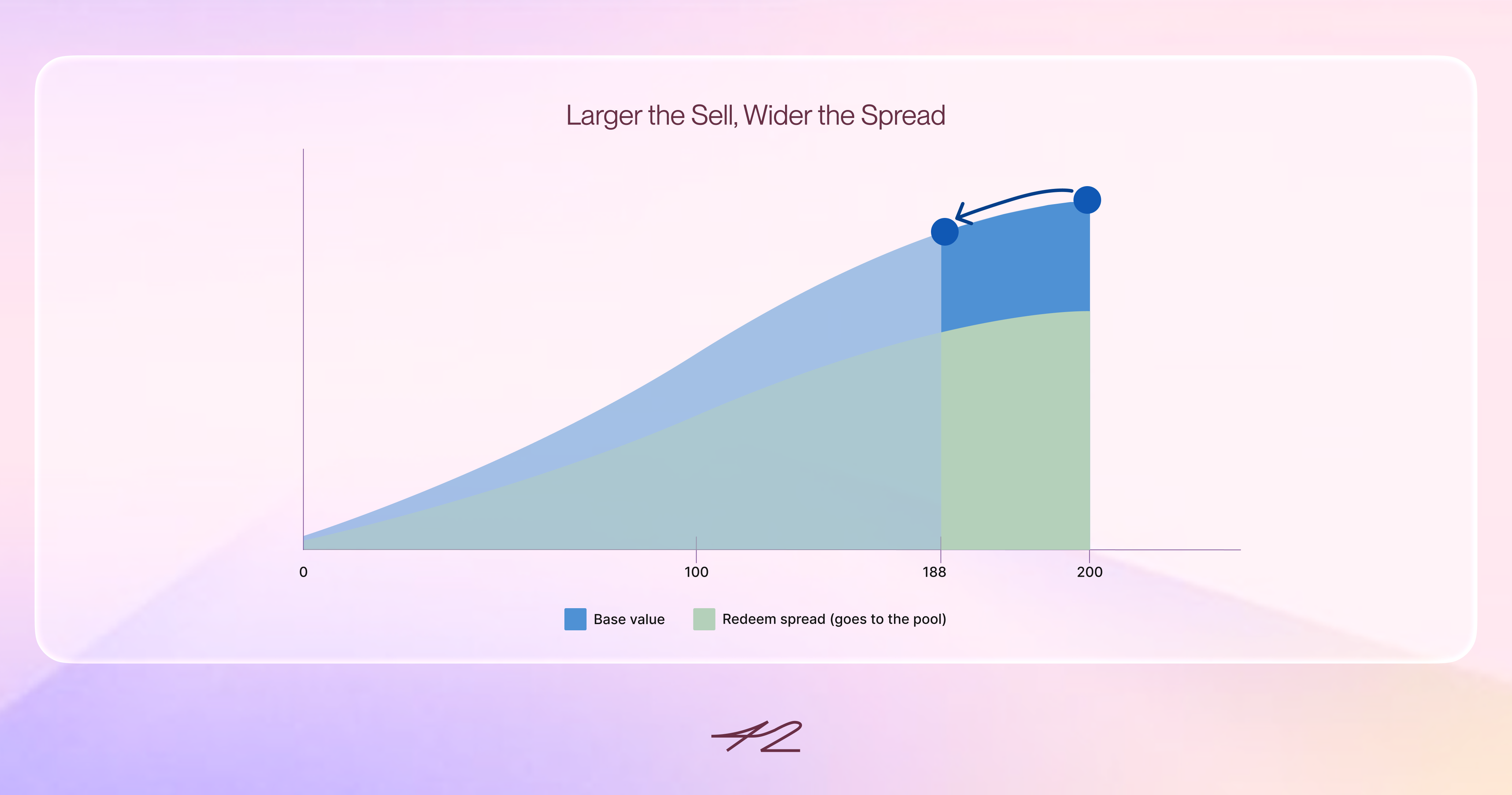
Suppose total outstanding supply decreases from **Q₂ → Q₁** as a user redeems **(Q₂ − Q₁)** tokens.\
\
The gross value is first computed from the mint curve (the reverse of minting). A redeem spread is then applied, so the user receives less collateral than the original mint cost for that same quantity.\
\
The withheld difference remains pooled in the market for eventual distribution to holders of the winning outcome(s).
{% endhint %}
#### **Redeem Tax Explained**
A **dynamic redemption tax** is applied to redemptions, increasing as the market approaches resolution. The function of it satisfy three core properties:
1. **Size-to-supply sensitive**\
Redeeming a larger percentage of outstanding supply incurs higher spreads eg. *redeeming 10% of overall supply > redeeming 1%.*
2. **Liquidity Sensitive**\
Spreads tighten as total outstanding supply grows. This means *redeeming 1 OT when supply = 10 has a higher spread compared to when supply = 1,000.*
3. **Time-sensitive**\
Spreads increase as the market approaches resolution. This acts as an **information tax** on late-stage exits, when informational asymmetry is highest.
Collectively, this mechanism serves several purposes:
* **Discourages last-minute extractive exits** that exploit near-certain outcomes
* **Preserves the integrity of the collateral pool** for participants who remain exposed through resolution
* **Converts late-arriving information into retained market value**, rather than allowing it to be siphoned out
{% hint style="info" %}
The tax here serves as a structural tool that mirrors the concept of a ‘spread’ or slippage when it comes to trading given how it is governed mathematically via the power curve.
{% endhint %}
#### **Impact on Price Stability**
The presence of a redemption tax meaningfully improves market behavior near resolution:
* **Reduces volatility spikes** by dampening abrupt exit incentives
* **Acts as an information-sensitive friction**, increasing the cost of low-conviction, late-stage trading
* **Protects long-term participants** from adverse selection by short-term, certainty-driven exits
The power curve and redemption tax shape market dynamics to better reflect crowd consensus as information becomes clearer. This ensures that price formation remains orderly throughout the different phases of the market lifecycle, and that final payouts reward accumulated positioning over opportunistic timing.
---
# Agent Instructions
This documentation is published with GitBook. GitBook is the documentation platform designed so that both humans and AI agents can read, navigate, and reason over technical content effectively. Learn more at gitbook.com.
## Querying This Documentation
If you need additional information that is not directly available in this page, you can query the documentation by asking a question.
Perform an HTTP GET request on the following URL with the `ask` and `goal` query parameters:
```
GET https://docs.42.space/getting-started/protocol-mechanics-101/42-outcome-tokens/market-discovery-pre-resolution.md?ask=&goal=
```
`ask` is the immediate question: it should be specific, self-contained, and written in natural language.
`goal` is what the user is ultimately trying to achieve, the reason they need the answer. Sharing it helps GitBook give you a better, more relevant answer. A goal is most helpful when it describes the outcome the user wants rather than restating the question. For example, with `ask=how do I create an API token`, a goal like `automate deployments from our CI pipeline` lets GitBook tailor the answer to that use case.
The response will contain a direct answer to the question and relevant excerpts and sources from the documentation.
Use this mechanism when the answer is not explicitly present in the current page, you need clarification or additional context, or you want to retrieve related documentation sections.