> For the complete documentation index, see [llms.txt](https://docs.42.space/llms.txt). Markdown versions of documentation pages are available by appending `.md` to page URLs; this page is available as [Markdown](https://docs.42.space/getting-started/publish-your-docs/trading-eventcoins/spotting-opportunities-for-exit-and-entry.md).
# Spotting opportunities for exit and entry
There are two simple ways to find opportunities on 42: By Event Markets and By Outcome Tokens. Choose the view that matches how you like to trade.
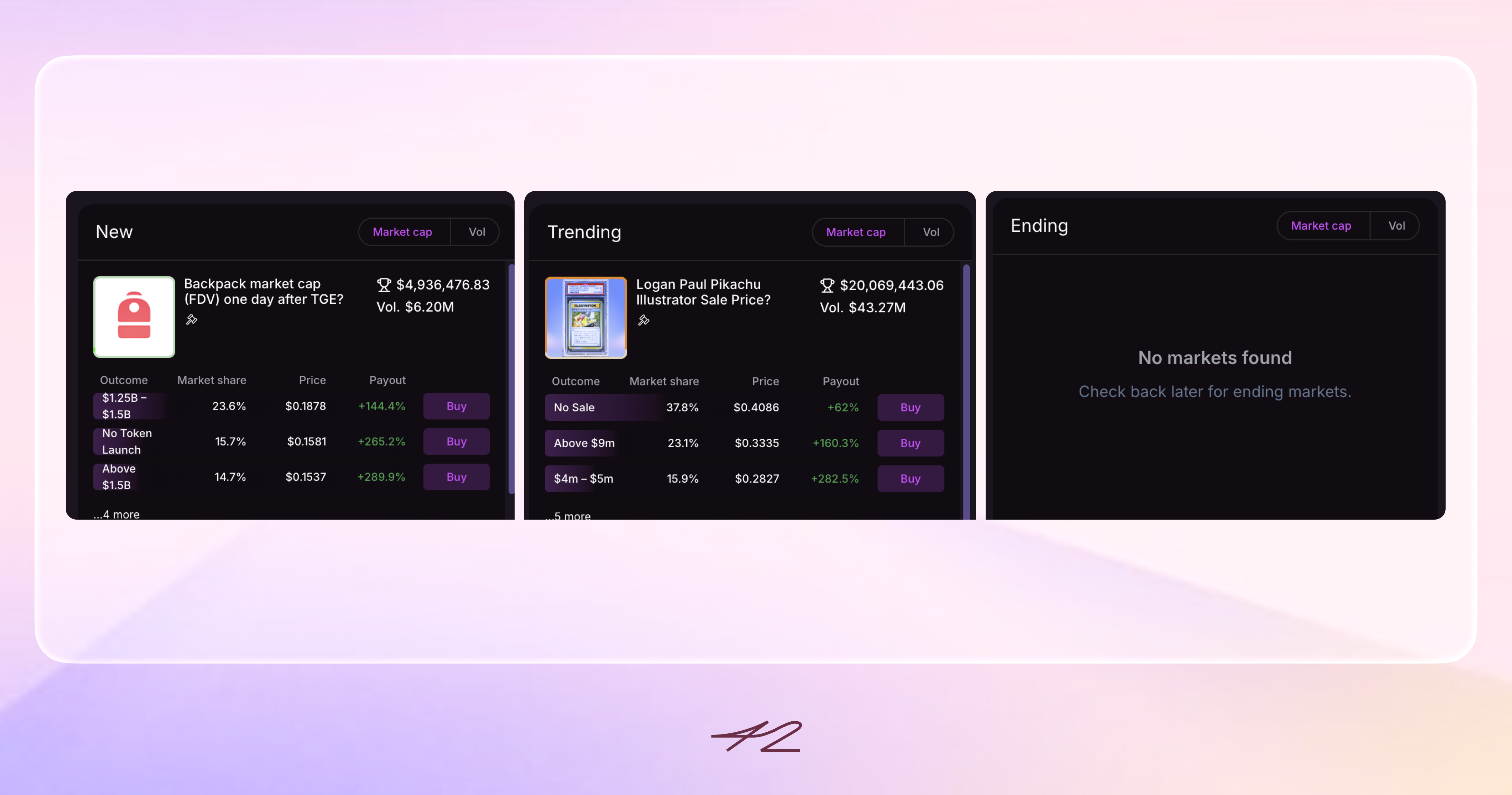
### Discovering markets
Markets are organized into three columns to reflect an event’s lifecycle and help you time entries and exits
* `New`: Early-stage markets. Outcome token prices can be low and potential payout multipliers high if you build a position before broader attention arrives. Suitable for conviction-driven entries and smaller, exploratory positions.
* `Trending`: Markets with significant recent trading activity. High activity often signals price discovery in progress. Look for dislocations (strong buying or selling) that create short-term momentum or mean-reversion trades.
* `Ending`: Markets approaching resolution. Trading will stop soon, and remaining holders will wait for settlement to determine winners and losers. Use this view for late-stage positioning, hedges, or to close trades before settlement. Learn more about the payout mechanism in [Convex Payout Dynamics](/getting-started/protocol-mechanics-101/convex-payout-dynamics.md)
{% hint style="info" %}
Tips
* In `New` markets, start small and add size as liquidity and information improve over time
* When looking at `Ending` markets, be explicit about your plan: exit pre-settlement or hold through resolution
{% endhint %}
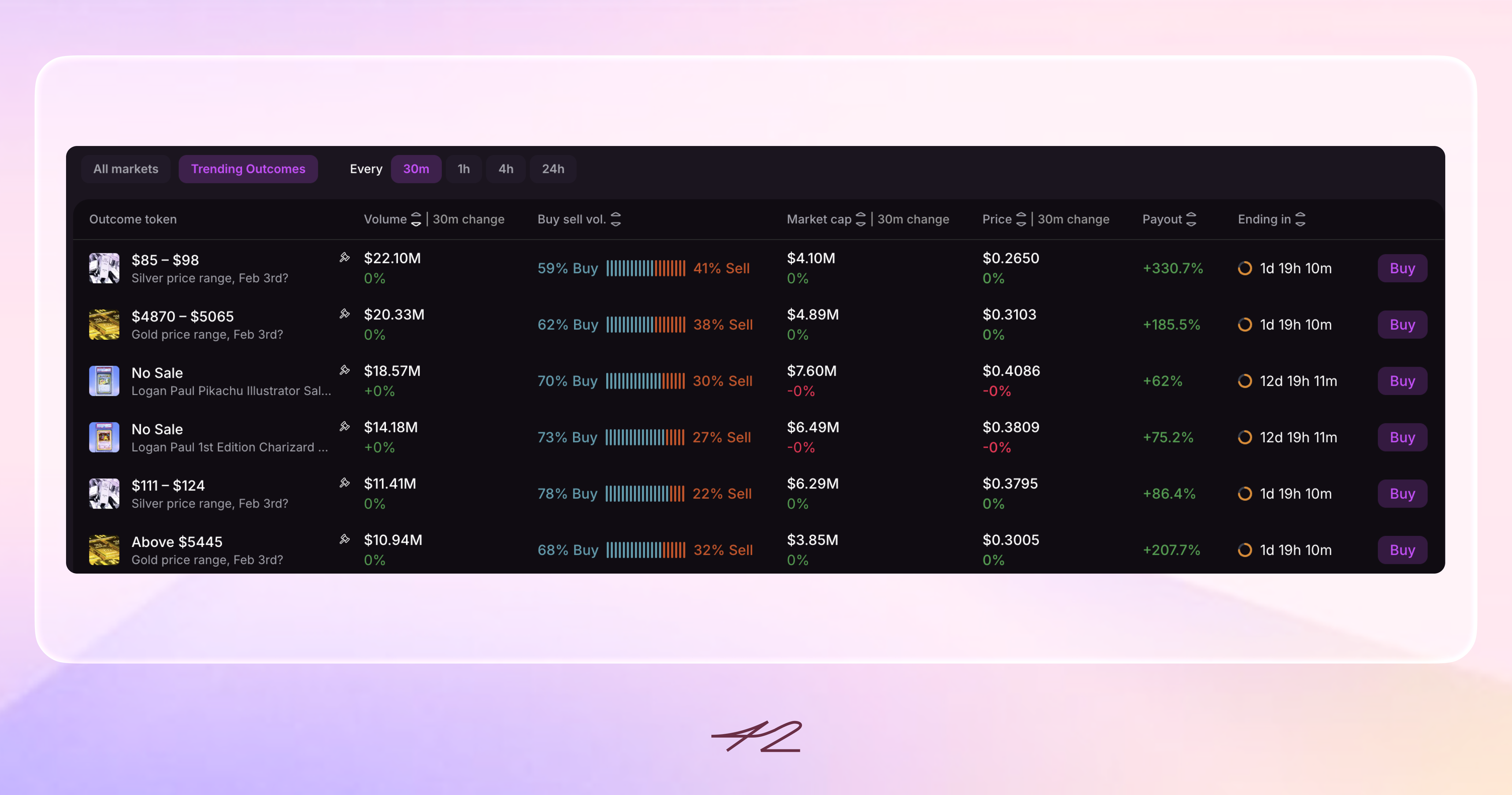
### Discovering outcomes
This table surfaces the most active outcomes across all markets, regardless of the market’s lifecycle. It ranks outcomes by volume at the top, highlighting where attention and order flow are concentrated.
What volume can mean:
* **Heavy selling:** Participants may be exiting or de-risking (potential overshoots to fade)
* **Aggressive buying:** A developing narrative or new information (momentum continuation setups)
* **High churn:** Two-sided trading with frequent reversals (range or scalp setups)
How to use this view:
* Scan the buy and sell ratio column to find where the action is quickly
* Refine your exit or entry plan by pairing outcome activity with the stage of the market (how soon is it ending)
* Switch time windows (e.g., 30m, 1h, 4d) to see how market cap, price, and payout evolved over time. Use shorter windows for timing entries; use longer windows to understand the broader trend and where volatility clusters
---
# Agent Instructions
This documentation is published with GitBook. GitBook is the documentation platform designed so that both humans and AI agents can read, navigate, and reason over technical content effectively. Learn more at gitbook.com.
## Querying This Documentation
If you need additional information that is not directly available in this page, you can query the documentation by asking a question.
Perform an HTTP GET request on the following URL with the `ask` and `goal` query parameters:
```
GET https://docs.42.space/getting-started/publish-your-docs/trading-eventcoins/spotting-opportunities-for-exit-and-entry.md?ask=&goal=
```
`ask` is the immediate question: it should be specific, self-contained, and written in natural language.
`goal` is what the user is ultimately trying to achieve, the reason they need the answer. Sharing it helps GitBook give you a better, more relevant answer. A goal is most helpful when it describes the outcome the user wants rather than restating the question. For example, with `ask=how do I create an API token`, a goal like `automate deployments from our CI pipeline` lets GitBook tailor the answer to that use case.
The response will contain a direct answer to the question and relevant excerpts and sources from the documentation.
Use this mechanism when the answer is not explicitly present in the current page, you need clarification or additional context, or you want to retrieve related documentation sections.